VoxAnima — Grounded RAG Knowledge System
Overview ~
Building a production RAG system that answers only from validated sources — zero hallucination by design.
VoxAnima is a grounded AI knowledge system I built for Sander Hicks — a Retrieval-Augmented Generation (RAG) application built around a curated body of Jewish religious and scriptural content. Unlike typical chatbots that generate plausible-sounding answers from general training data, VoxAnima answers only from its validated source material and explicitly refuses when the data isn't there. Every answer comes with source attribution and a byline so users can trace exactly where each piece of information originated. The system is built to be a doctor of its domain — deeply knowledgeable within its scope, and honest about the boundaries of what it knows.
Challenge ~
Engineering an AI system that never hallucinates — with source attribution, boundary checking, and eval-driven accuracy.
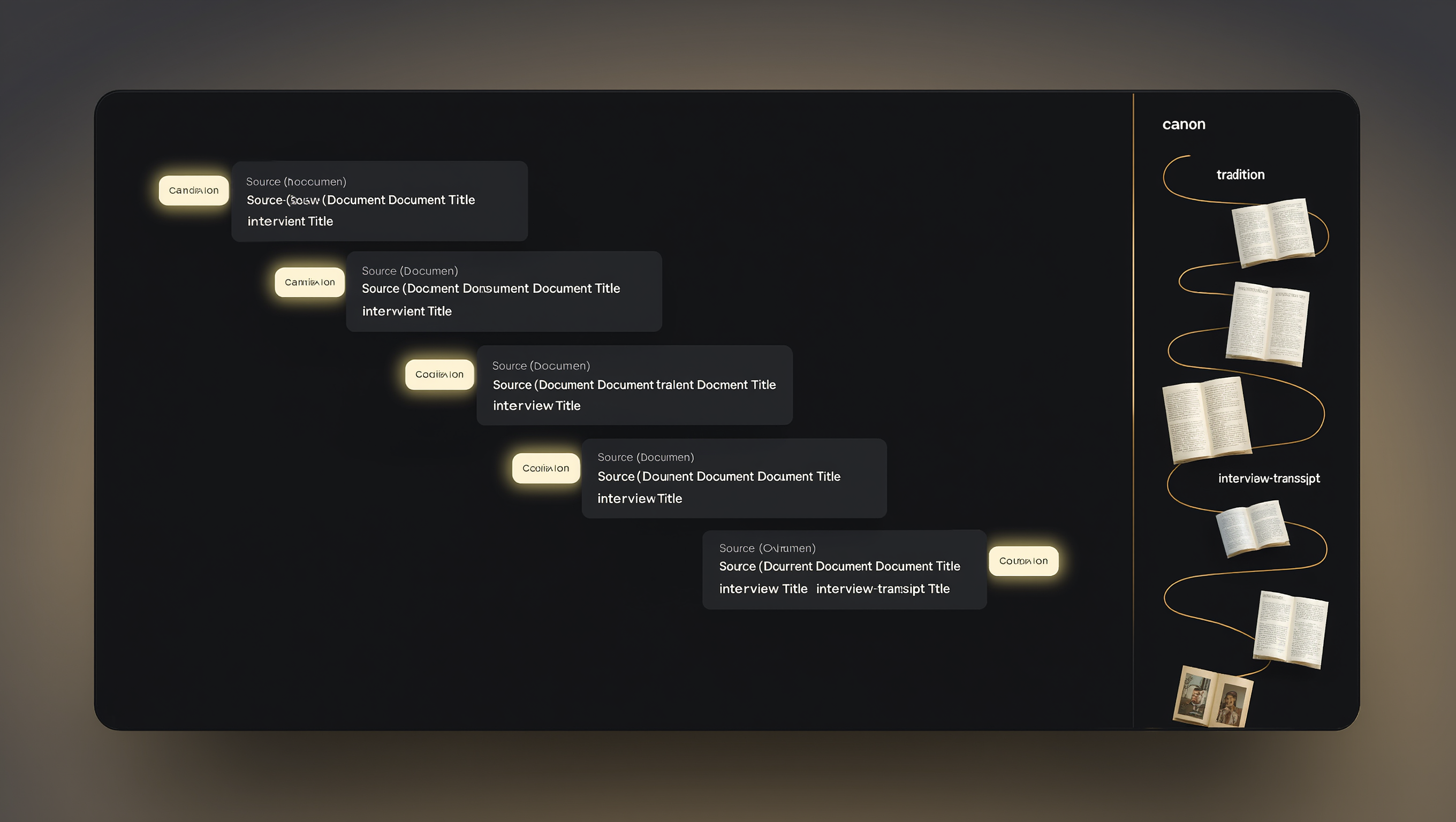
The core challenge was building an AI system that is trustworthy by architecture, not by hope. The knowledge base spans 35 files across three categories — 22 canon files (core scriptural and educational content), 6 Slingshot files, and 7 Rabbi Andrew Kahn interview transcripts. Each document needed custom chunking strategies with appropriate overlap and size limits. The system had to tag every chunk with metadata (author voice, tradition, copyright type, content layer) so retrieval could be precise and attribution could be specific. On top of that, the system needed strict boundary checking — it must never surface politically sensitive content — and a confidence routing system so uncertain answers are flagged rather than presented as fact.
Reviews ~
A RAG system that proves AI can be trustworthy — every answer cited, every boundary respected.
VoxAnima shipped as a production system where every answer is grounded in source material with full attribution. The byline system shows exactly which author and document each piece of information comes from — including distinguishing between direct quotes, educational commentary, and interview transcripts. The boundary checking ensures the system stays within its domain. The eval suite validates that any change to the retrieval or generation pipeline actually improves accuracy before it ships.
“Musawir built exactly what I needed — an AI system that knows its material deeply and is honest about what it doesn't know. The source attribution gives users real confidence in every answer.”
Sander Hicks
Solutions ~
Retrieval-calibrated RAG with chunking pipelines, source attribution, confidence routing, and eval-driven development.
Built a custom ingestion pipeline that processes 35 documents through configurable chunking (1,500 char max with overlap), generates embeddings via Voyage AI, and stores everything in Supabase with rich metadata tagging — author_voice, tradition (e.g., 'jewish'), copyright type (e.g., 'interview-transcript'), and content layer. The CLI supports selective ingestion (e.g., 'npm run ingest -- kahn' for just interview files) and full re-ingestion with deduplication. Each chunk carries enough metadata for the retrieval system to make informed decisions about relevance and the attribution system to generate accurate bylines.
Designed a confidence routing system where the AI evaluates its own certainty before responding — uncertain answers are surfaced loudly rather than silently fabricated. Built boundary checking that prevents the system from engaging with politically sensitive topics, maintaining focus on its domain of religious and scriptural scholarship. The eval suite runs against known question-answer pairs to validate that retrieval changes actually improve accuracy. The entire system follows a deny-by-default philosophy: nothing reaches the user unless it passes extraction validation, confidence thresholds, and boundary checks.